A Computation on the Passage of Time
(with cellular automata)
A musing on understanding circumstance
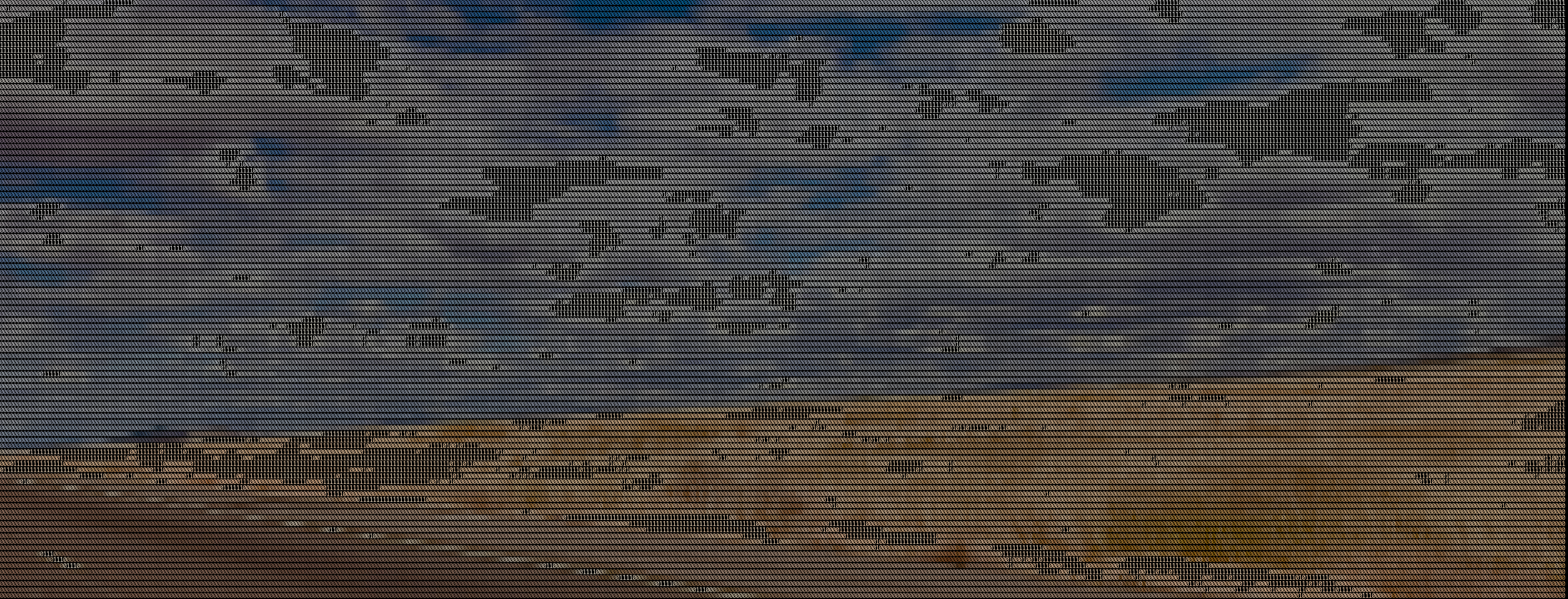
that brilliant meadow
Since the last time I have updated my substack, it seems as if several lifetimes have passed, each with the unique complexities, joys, and despairs that come with. Of course, some things have remained throughout—some places; some people. To them I am grateful. Yet, we often do not remember our lives by what has remained, but rather in what has so wildly differed from the last index of our surroundings.
A few weeks ago, I was driving my mother north on some trivial errand. The interstate road that we took was one that I had driven on for many, many years. I’ve probably made that drive hundreds of times. An identical winding path, carving hundreds of miles of memory within my mind. I believe the first time I drove this path was alone in 2017 as a teenager, eagerly searching for some place to set up camp for the weekend on a cold day in mid-February. Regardless of any personal attachment to the I-17 North, I have always enjoyed noting the physical journey, more specifically what I was able to see during. There is a specific stretch of land, about 45 minutes into the journey, in which you will come up through a winding mountain pass and upon emerging from its exit, be greeted with a seemingly infinite field of dry shrub-grass. An eternity of swaying golden reeds that extends as far along the horizon as you are able to see. It is truly a sight to behold, particularly at sunset; and for those unaware, when the light, clouds, and the sky feel particularly magnanimous, there is no more resplendent a sight than the evening redness of the American West.
But it does not always look this way.
our brain’s perception of time
In my observations of this grassy field over the years in which I have driven by and witnessed it, it is more than apparent that this stretch of land is extremely prone to wildfire. While this is far from some novel revelation, the point is that the grass coverage is always different every time I have observed it. There has been many a time when I saw nothing but a charred wasteland, and seeing it some time later it had returned to its previous Elysian state. Quite ostensibly, it seems as if this change in its beauty is dependent on its previous state. Namely, state that I had previously only observed when it was drastically different in a sort of selective attention/frequency bias. I know that the field does not exist in two states; the field exists in a continuous range, such that it would be reductive to model natural phenomena as a state machine at all. Yet, I question if our brains are generally inclined to the modeling of natural phenomena as a state machine, despite knowing full well internally that this is an inaccurate perception of reality. I start to wonder: is our perception of time stochastic? Is reality built upon some sort of extremely-long and complex chain of events, or are our perceptions of events in our lives inevitably limited in their scope? It bothered me deeply to not be able to trace the causation of my observations.
Time is modeled as a continuous parameter. There are some contentions otherwise such as block universe theory, but we will stick to the common perception for the sake of this article. Time itself cannot possibly be stochastic in nature; rather, my musings were about the ways in which it is measured. As time itself has no physical properties to actually observe, the only way to really measure the passage of time at all is to observe objects & events at different points. From our perspective, choosing to revisit an event/place is the only way to know if any time has passed at all. We know that time has passed to our perception because we remember its previous state. However, in a vacuum, can it really be said that if the field a year ago and the field now looked roughly the same to my naked eyes, could I even tell that they differed from each other if every memory of my life between then and now was somehow deleted? Almost certainly not. If our perceptions is physically unable to observe any phenomena continuously, is it even possible to determine the origin of any event such as the coverage of the grass and decide whether or not the emergence of any arbitrary phenomena is deterministic?
If you have a definite answer to that question, I would love to know it. Otherwise, I contend that our perception of time is a stochastic process, since our experience of the world at any point in time is based on the state of the world at the point of observation. Since the state of the world during any arbitrary event is seemingly random, then suffice to say our perception of events at any time is the same. We encounter our environment in a sort of checkpoint system, the observability of events bound to a stochastic, discrete process. It is not time itself that subjects the field to the random processes of change, nor is it the nature of the field itself, but almost certainly a vast combination of inscrutable phenomena that are obfuscated to us by our limited ability to observe. The field’s state is random because it is likely influenced by things such as humidity, temperature, wildlife interactions, wind, rainfall, seed dispersal, and so on and so forth. There is likely an uncountable amount of intersectional variables that are inherently unpredictable, and (possibly) fully unpredictable at quantum levels. As such, the basis for our observations of reality could or could not be deterministic (depending on what you believe in), but our observability will always be epistemically stochastic since we are finite observers of this world. That is, our observation will always be bound by uncertainty from a lack of complete information, regardless of whether or not the universe itself is actually random or otherwise.
from cellular automata
In trying to make sense of this world, the techniques and instruments we utilize in order to understand it also tend to fit to our understanding and are limited by our nature. I will use an example from computational simulation: Conway’s Game of Life. For those who are unfamiliar, the Game of Life is a devised by John Conway in 1970 and is essentially a set of rules for simulating artificial life through computation. Theoretically, it occurs on an infinite grid of cells where each cell is in one of two possible states (sound familiar?): alive, or dead. A 1, or a 0. Each cell interacts with its adjacent neighbors at every time step in a certain way:
- Any live cell with fewer than two live neighbors dies (underpopulation)
- Any live cell with two or three live neighbors lives on to the next generation.
- Any live cell with more than three live neighbors dies (overpopulation)
- Any dead cell with exactly three live neighbors becomes a live cell (reproduction)
The Game of Life is a 0-player game, whose outcome is determined entirely by the starting state of the game. However, unlike our perception of reality: the Game of Life is actually completely deterministic. Given the same starting “seed” of randomness, the final outcome of the simulation will always be the same.
Here’s a basic example so you can understand what it’s supposed to look like.
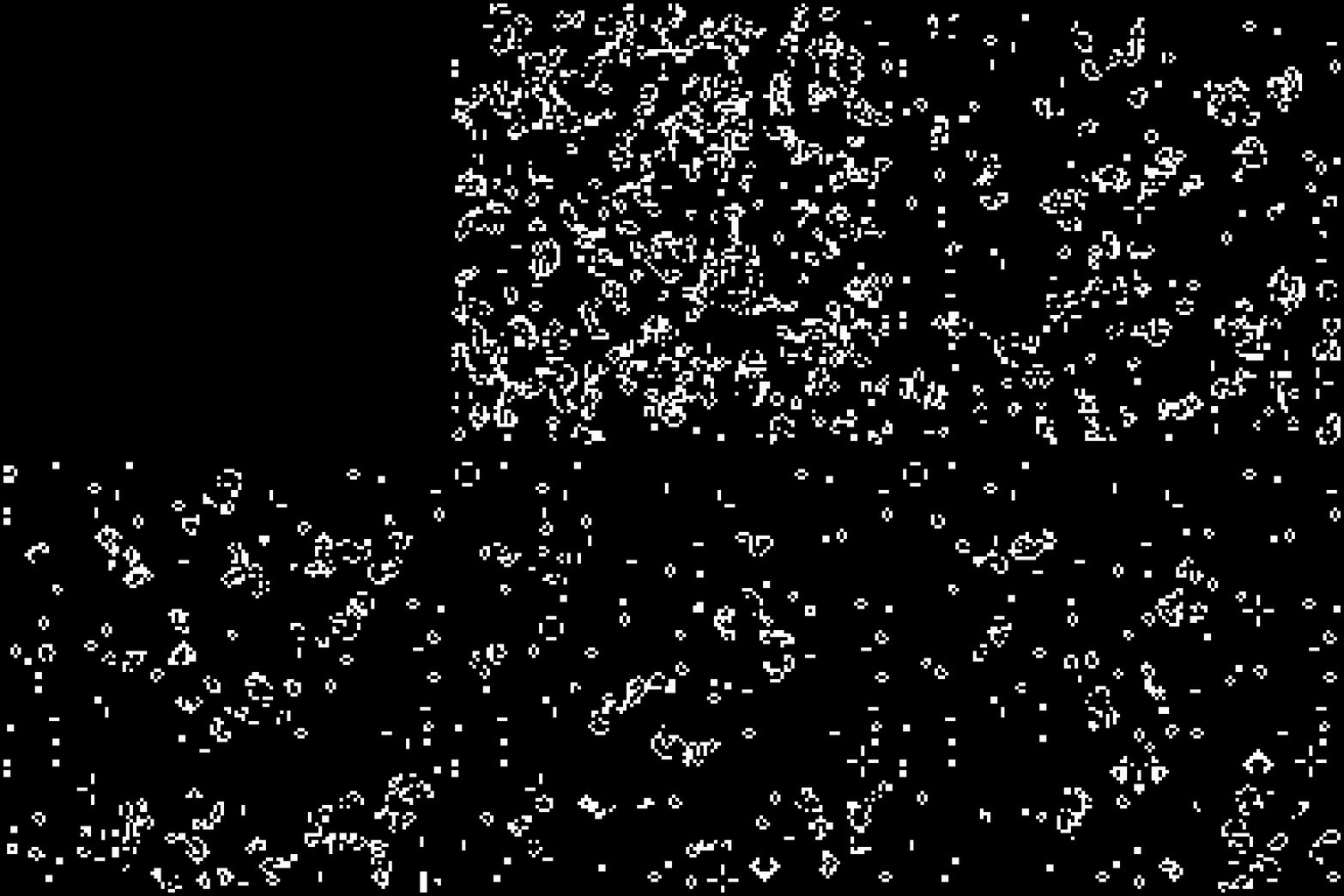
Now let’s scale it up and make it more fancy still with the same seed.
What I notice, and perhaps this is a limitation of the bounds of my own mind, is that even knowing that these simulations are bound by their starting state and inherent rules, I am able to determine neither the final state of the simulation nor the path that leads there, at least until I witness it in its entirety. Even if I know the outcome, and even if I also know that the outcome is predetermined, I see no more a pattern in this simulation of life than I can in the coverage of the grass in that field. The Game of Life is an entertaining analogue to what I am grasping at here. Even in our simulations, in one that is dependent and sensitive to conditions initial and discovered, the only way to truly see the outcome, let alone understand it, is to run it. Perhaps it is better to say that the state of the simulation is continuously and constantly unpredictable as opposed to being ‘random’. See it as such: imagine being one of these ‘cells’, trapped in a deterministic, rule-governed simulation that is theoretically infinite; even as one of them, it would be impossible to forecast any sort of outcome from your simple rules without undergoing the simulation. Even in a fully deterministic universe, a finite observer inside of it cannot predict its own future. There is no shortcut to the computation here, no shortcut to the end: the only way to understand the outcome is to run it.
Perhaps this is not so dissimilar to our existence.
understanding it all
Whether or not the universe we live in is deterministic or not is a discussion for another time; rather, I ask of you—from your experiences, can it be said that our lives are all that different to being a cell in the Game of Life? We live in a world that has some intrinsic complexity to it, born from simple components, yet there are things that will remain impossible to forecast in their entirety. We are bound to the whims of this world; there is no shortcut to the calculus of all of the events that comprise us. As trite as it is to say: you must live your life to understand it. You must continue to live it! Past all of its hardships and torpor, those slings and arrows, we must see it through to the end.
So I thought upon seeing that field—I wish that I could see all of its change. I wish I could see the stack trace of everything that had coalesced into creation what lay before my feet. I wish that it were possible to make itself known to me; that I could witness it all in some continuous manner so I would not miss a second of observation. Perhaps then I could understand it. Really understand it. Fundamentally and deeply, in a way that satisfied me and brought me some sense of fulfillment. I think this of my woes as well. I think this of those I have wronged and those who have wronged me, I think this of every time I have failed and every time I have suffered. If I could have just seen every step of its happening, scrutinized it all, and understood it deeply and completely…that I could have avoided the outcome. That those circumstances might have changed. I wonder sometimes if it is some curse of humanity to be limited by the inadequacy of our observations, and the depth (or lack thereof) of our horizons.
the gift of ephemerality
On the contrary, I think it is a gift. I think it is one of the very few gifts that is offered to us in this life. All those macroscopic outcomes that constitute each of us have some impossibly long causal chain of origin that we will never be privy to understanding. Maybe the field of grass is not golden because of some random set of fluctuations, but because everything in the world had conspired to make it so.
Who knows!
What a beautiful thing it is that we are unable to truly trace anything; what a wonder it is to not understand. It is only through this lack of knowledge that anything we observe is even considered phenomena. The fact that moments are fleeting is what makes them worth remembering at all.
We are finite observers of a seemingly random and infinite world. To us, the state of the world at any given point in time is stochastic simply due to the complexity of interactions that are beyond our scope of understanding, and our physical inability to observe anything and everything simultaneously. We can not predict our own futures with any more certainty than we can be sure the past happened the way it did in accordance to our memory. I think this is a kind of providence. Perhaps it is, if nothing else, a great gift that our perceptions are limited. Limited so that we may experience the things that imprint our humanity: to look back fondly on the past, to look towards tomorrow, to enjoy good company. To take notice that even after everything that happens between point A and B, then and now, you have somehow remained—though changed you may be.